Frequently Asked Questions (FAQs) About Sourcing Stick Packaging
Stick packaging combines engineering precision with user-friendly mechanics to deliver solid formulations smoothly and consistently. From lip balms to deodorants to solid serums, the propel/repel mechanism must withstand repeated use while maintaining product integrity. Whether you're developing a compact twist-up tube or a large-format applicator, understanding barrel materials, elevator designs, and mechanism tolerances is essential for sourcing packaging that performs flawlessly. Explore key FAQs below to navigate materials, mechanisms, and customization options.
Understanding Stick Packaging Anatomy
What are the primary components of a stick component?
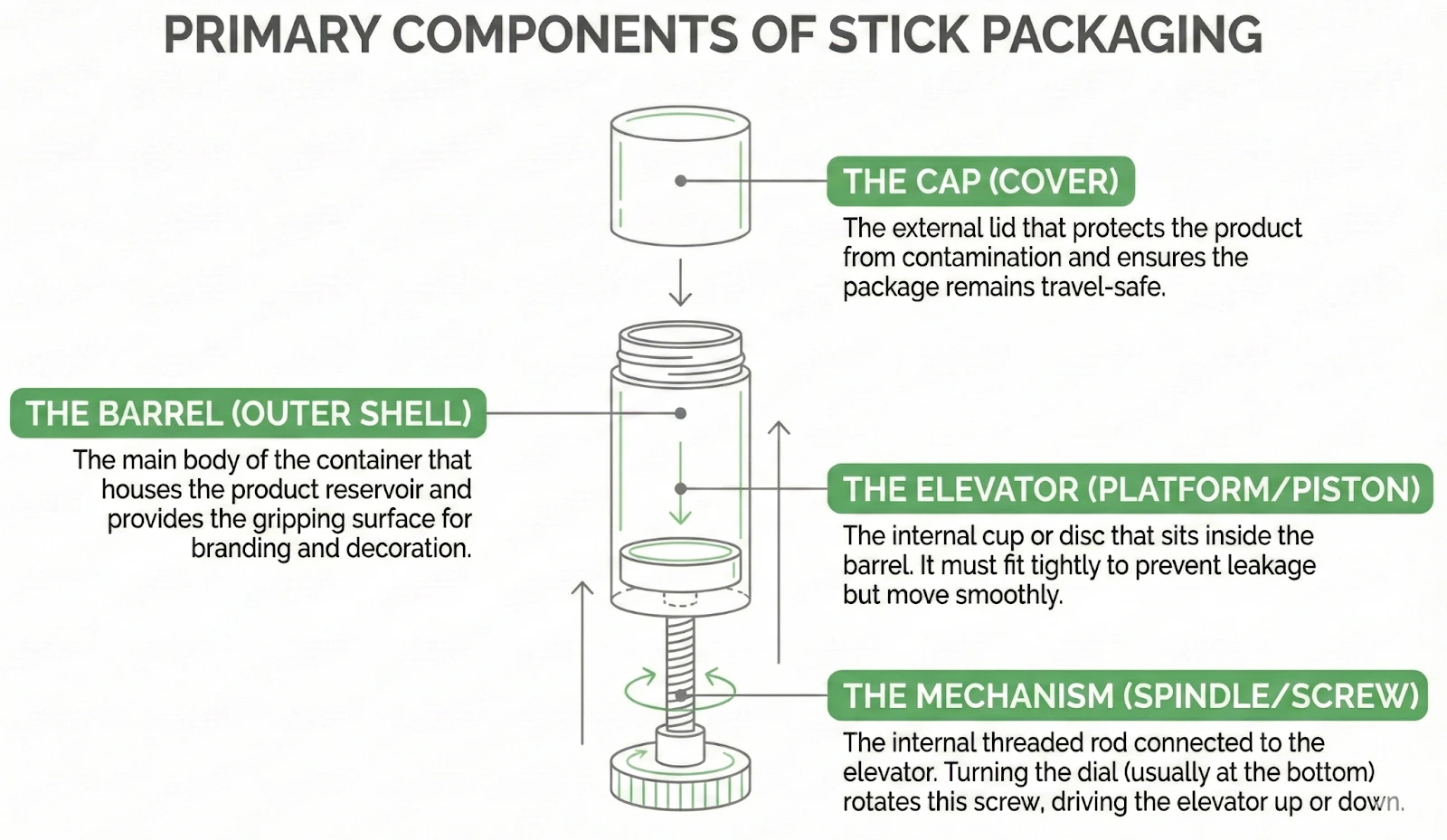
While designs vary between simple lip balms and complex deodorant sticks, the fundamental anatomy of a propel/repel container includes four to five key components:
- • Cap (Cover): The external lid that protects the product from contamination and ensures the package remains travel-safe.
- • Barrel (Outer Shell): The main body of the container that houses the product reservoir and provides the gripping surface for branding and decoration.
- • Elevator (Platform/Piston): The internal cup or disc that sits inside the barrel. It must fit tightly against the barrel walls to prevent leakage but move smoothly to push the product upward.
- • Mechanism (Spindle/Screw): The internal threaded rod connected to the elevator. When the user turns the dial (usually at the bottom), this screw rotates, driving the elevator up or down.
What is the plastic disc on top of the product often seen in deodorant sticks?
Often found in deodorants and high-end balms, this piece is called a Shive, Inner Disc, or Dome Fitment. It serves three critical functions:
- Molding the Shape: For bottom-filled products, this disc is inserted before filling. The hot liquid is poured against it, allowing the product to cool into a perfect, smooth dome shape.
- Prevents Shrinkage: It creates an airtight seal directly on the formula's surface, preventing volatile ingredients (like alcohol or water) from evaporating and causing the product stick to shrink or pull away from the walls.
- Hygiene & Tamper Evidence: It assures the consumer that the product has not been touched or tested prior to purchase.
Common Stick Packaging Applications
What types of products are stick packaging components commonly used for?
Stick packaging is engineered for high-viscosity, solid, or semi-solid formulas. Based on common industry categories, here are the primary applications:
- Deodorant Sticks
- • Standard Format: Oval or round barrels with a propel/repel (twist) mechanism.
- • Capacity: Typically 30g – 75g (1oz – 2.5oz).
- • Key Feature: Wide application surface designed for underarm coverage.
- • Trend: Refillable cases with replaceable inner cartridges are growing in popularity to reduce plastic waste.
- Hair & Body Sticks
- • Format: Often larger, wider sticks (sometimes called "jumbo" or "chubby" sticks) to cover larger skin areas quickly.
- • Applications:
- • Hair: Wax sticks for flyaways, styling pomades, and solid shampoo bars.
- • Body: Anti-chafe balms, solid body butters, muscle relief balms, and body blur/shimmer sticks.
- • Key Feature: Robust mechanisms designed to handle harder, waxier formulations without jamming.
- Lip Balm Sticks
- • Format: Slim, pocket-sized cylindrical tubes (approx. 15mm diameter).
- • Capacity: 4g – 7g (0.15oz – 0.25oz).
- • Mechanism: Simple twist-up bottom.
- • Trend: "Push-up" paperboard tubes are increasingly replacing plastic for a 100% plastic-free option.
- Sunscreen Sticks
- • Format: Often flat, wide, or teardrop-shaped for ergonomic handling and targeted application on the face (nose, ears, forehead).
- • Key Requirement:
- • Airtight Seals: Many sunscreen sticks require airtight caps to prevent volatile ingredients from evaporating.
- • Material: Must be compatible with chemical UV filters (often requiring PP or specific barrier liners).
Technical Considerations: Top Fill vs. Bottom Fill
What’s the difference between Top Fill and Bottom Fill stick containers?
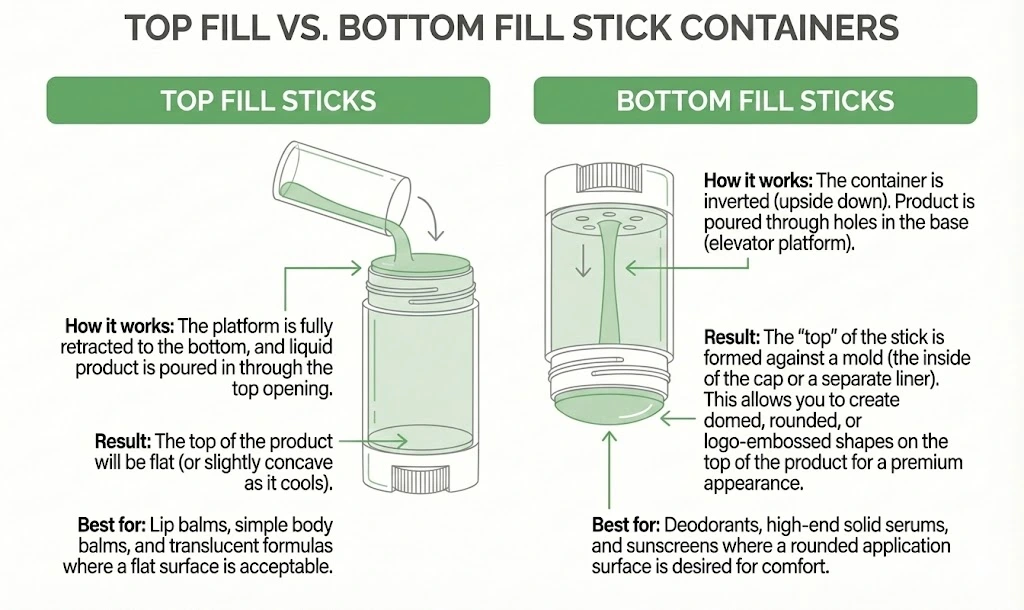
The choice dictates your filling process and the final look of the product:
- • Top Fill Sticks:
- • How it Works: The platform is fully retracted to the bottom, and liquid product is poured in through the top opening.
- • Result: The top of the product will be flat (or slightly concave as it cools).
- • Best For: Lip balms, simple body balms, and translucent formulas where a flat surface is acceptable.
- • Bottom Fill Sticks:
- • How it Works: The container is inverted (upside down). Product is poured through holes in the base (elevator platform).
- • Result: The "top" of the stick is formed against a mold (the inside of the cap or a separate liner). This allows you to create domed, rounded, or logo-embossed shapes on the top of the product for a premium appearance.
- • Best For: Deodorants, high-end solid serums, and sunscreens where a rounded application surface is desired for comfort.
Manufacturing & Customization
What is a dual-ended cosmetic stick?
A dual-ended stick features two separate product reservoirs and applicators in a single unit, typically meeting in the middle. This is ideal for multifunctional products, such as a contour shade on one end and a highlighter on the other, or a lip color paired with a cheek tint. They reduce pack count for the consumer and offer a high-value "2-in-1" solution.
Are there sustainable options for stick packaging?
Yes, suppliers are increasingly offering eco-conscious stick solutions:
- • Mono-Material Sticks:Traditionally, sticks used multiple plastics (PP, PE, POM) for the mechanism, making recycling difficult. New mono-material designs use a single resin (usually Polypropylene - PP) for the cap, barrel, and mechanism, making the entire unit recycle-ready.
- • Sticks made with PCR (Post-Consumer Recycled): Sticks made with 30-100% PCR plastic reduce reliance on virgin fossil fuels.
- • Refillable Sticks: Premium "keepsake" cases allow consumers to purchase simple refills.
Industry Applications & Suppliers
Which packaging suppliers specialize in stick packaging?
When sourcing stick packaging, it is critical to find a partner that fits your specific needs, whether that is full-service manufacturing or specialized component sourcing.
- • Samhwa Korea
- • Location: South Korea
- • Specialties: A Korean innovator known for pushing the boundaries of stick format design. Samhwa specializes in refillable stick mechanisms, airtight stick packaging, and sunscreen sticks - making them a strong partner for brands prioritizing sustainability, formula protection, and next-generation stick formats.
- • Federal Package
- • Location: Minnesota, USA
- • Specialties: A turnkey solution for brands seeking "Made in USA" speed and quality. Federal Package is both a manufacturer of containers and a contract filler. They specialize in deodorant, lip balm, and sunscreen sticks, offering end-to-end services from R&D formulation to filling and retail-ready packaging.
- • WWP Beauty
- • Location: Taicang, China
- • Specialties: Ideal for brands looking for a vast library of "on-trend" stock options. WWP Beauty offers an extensive range of stock stick components, including their award-winning "Refill Revolution" multi-use face and body sticks. They are known for premium decoration capabilities and sustainable material options like PCR and bio-resins.
- • Choebe Group
- • Location: Dongguan, China
- • Specialties: A powerhouse for mass-market and prestige cosmetic sticks. Choebe offers a wide variety of stock molds including chubby sticks, dual-ended pens, and slim concealer sticks. They are highly capable in custom decoration, offering intricate silk screening, hot stamping, and custom coloring to elevate stock components.
- • JCOP Korea (Jeong Hun)
- • Location: South Korea
- • Specialties: The go-to source for K-Beauty innovation and high-quality lipstick mechanisms. JCOP specializes in precise dispensing systems for lipsticks, multi-sticks, and lip glosses. They offer an impressive library of stock molds with a focus on airtight seals and premium aesthetic finishes typical of the Korean beauty market.