If you're sourcing packaging for a product launch that pairs two formulas together, a dual chamber tube deserves a serious look. For formulas with actives that shouldn't come in contact until they're dispensed, this format solves a problem no standard tube can — keeping ingredients completely separate while delivering them from a single package.
Here's what dual chamber tubes are, where they show up, and how to source one.
Browse cosmetic squeeze tubes →
Browse dual-chamber airless bottles →
What Is a Dual Chamber Tube?
A dual chamber tube holds two separate formulas in one package. Each chamber is fully isolated from the other, so the ingredients inside never mix until you actually dispense the product. Depending on how the package is engineered, you can push both formulas out at the same time or dispense them one at a time.
The real value here isn't novelty alone — it's protection. Splitting a formula into two chambers is one of the more effective ways to keep incompatible ingredients apart, and that matters most for sensitive active ingredients, oxidation-prone formulations, unstable ingredient combinations, and high-performance skincare actives.
If your formula has two components that degrade the moment they meet, this is the packaging conversation you need to be having.
Types of Dual Chamber Tubes
Side-by-Side Dual Chamber Tubes
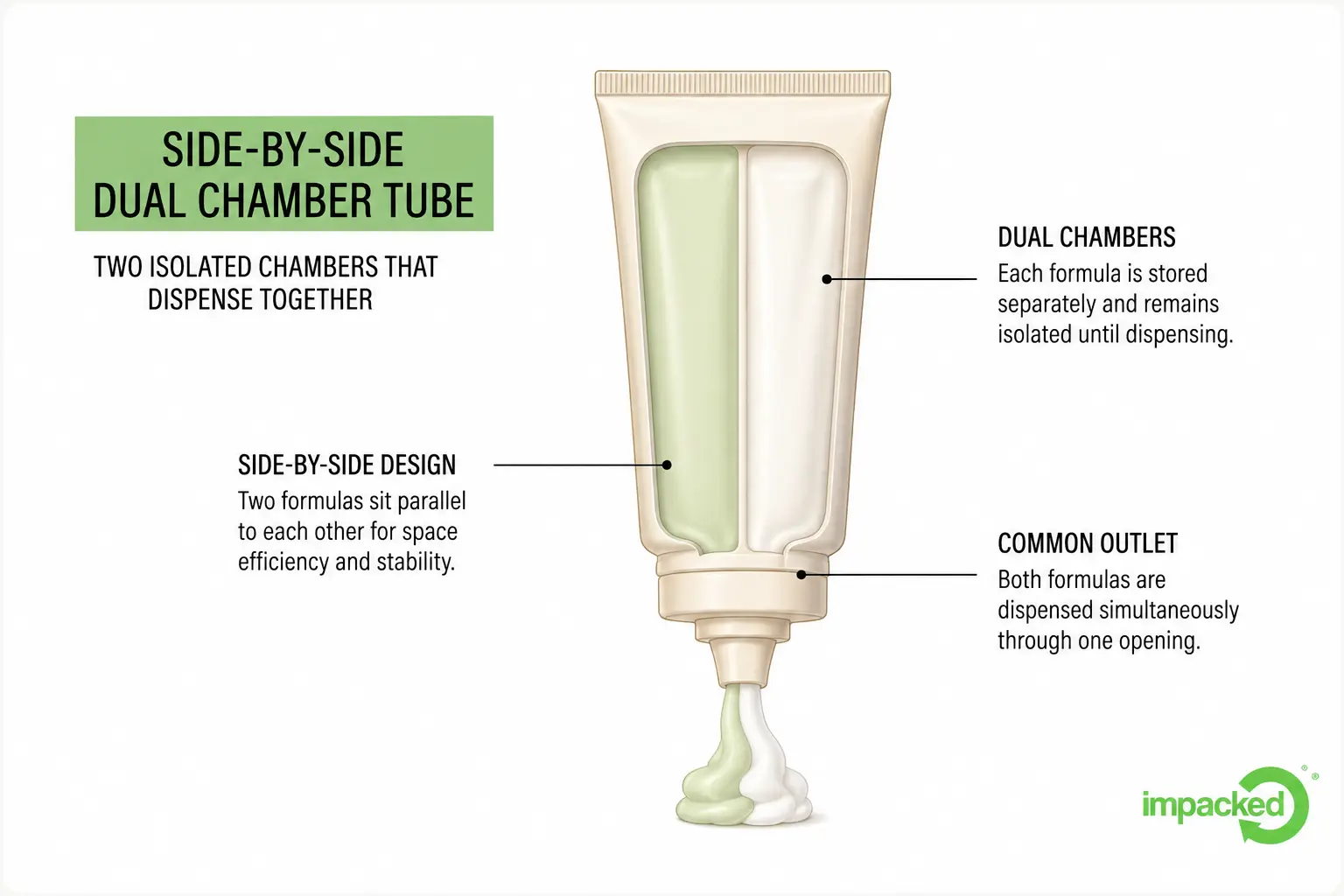
This is the standard dual chamber build. Two compartments run parallel to each other inside the same tube, each holding its own formula, fully isolated until the point of dispensing. It's the most common construction you'll come across when a brand needs two formulas kept apart but delivered from a single package.
Tube-in-Tube
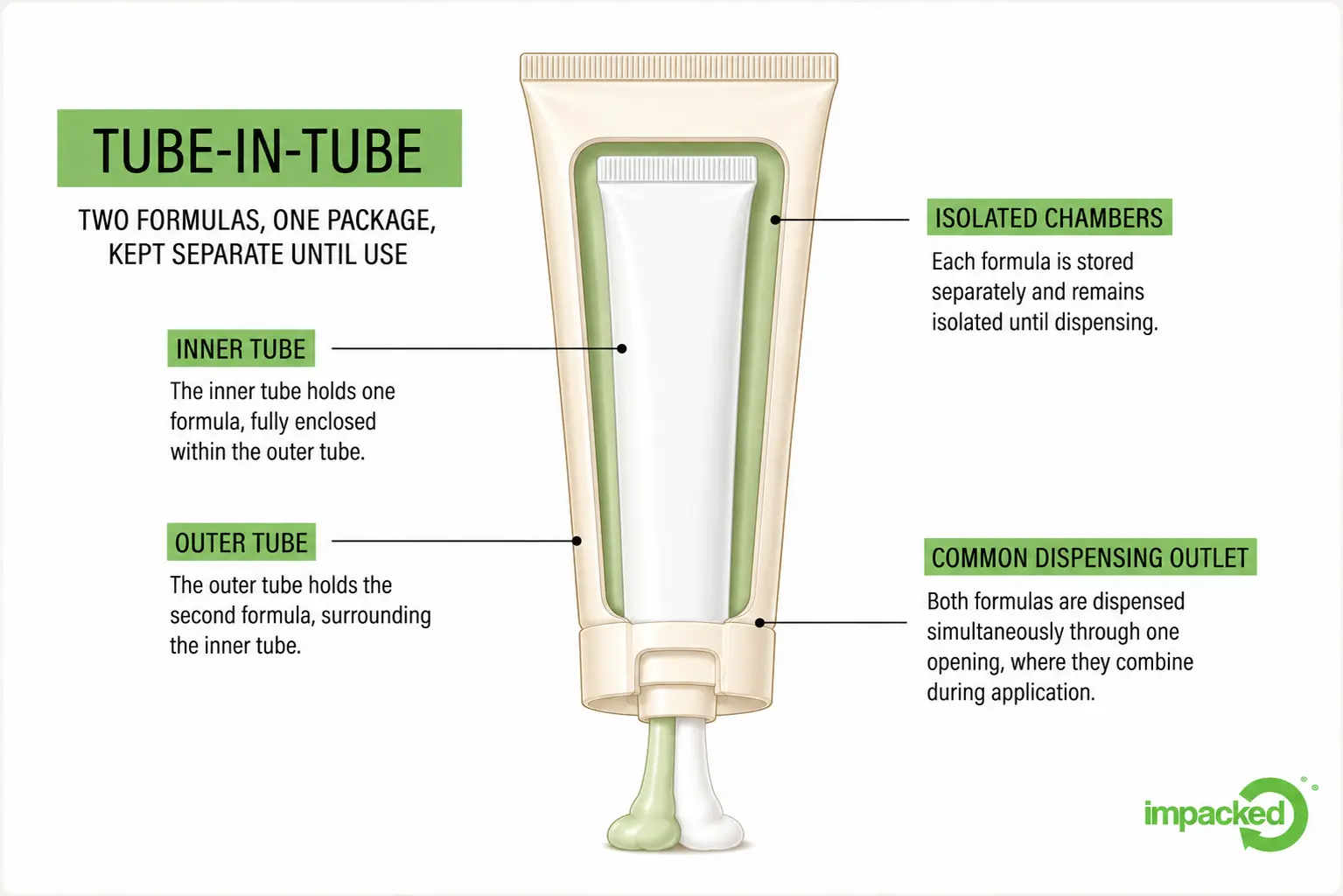
Instead of the two chambers sitting in parallel, tube-in-tube nests a smaller squeeze tube entirely inside a larger one. It's a different way of solving the same problem, and it's worth understanding both before you commit to either direction.
Stacked Dual Chamber Tubes
Stacked construction takes the opposite approach from side-by-side: instead of two chambers sitting next to each other, one sits on top of the other. That vertical stack shrinks the footprint of the tube, which is exactly why it tends to show up with thicker, cream-based formulas that need a more compact package. Depending on the dispensing head, the two formulas are dispensed simultaneously through separate or combined outlets before mixing during application.
Benefits of Dual Chamber Tubes
Potential Drawbacks
Common Applications for Dual Chamber Tubes
Dual chamber tubes show up across beauty, personal care, and beyond. The format works best when two formulas need to stay separate but be applied together:
Outside of beauty, the format shows up in topical medications that require precise ratios of a soothing ingredient and an active compound, in first-aid ointments that pair an antibacterial with a moisturizing base, and even occasionally in food and beverage for two-part sauces or dressings meant to combine right as they're used.
Dual Chamber Tubes in the Market
Dual chamber tube packaging isn't a hypothetical format — it's already on the shelf. Marc Anthony's Volume Cocktail Thick & Full Dual Styling Volumizing Cream uses a side-by-side twin chamber design, while The Face Shop's Rice Water Bright Milk & Jelly Double Cleanser uses a tube-in-tube construction.

Worth flagging though: dual chamber shows up far more often as dual-chamber airless bottles than it does in squeeze tubes. This is because the airless element is quite important for oxygen-sensitive actives, so two-in-one cosmetic tubes wind up being used more for routine or behavioral stacking.
What to Consider Before You Commit
Dual-chamber tubes can be a great solution for certain product launches, but you'll want to check with your filler to make sure they can actually run these on the line. These tubes can be double the trouble when it comes to filling, so you'll want to make sure that you're working with a co-man who has seen these before.
Cost is the other factor to plan for. Two chambers, tighter engineering tolerances, and a smaller supplier pool typically mean higher per-unit costs than a standard tube. It's worth budgeting for a dual chamber tube as a specialty component rather than a standard tube.
Best Dual Chamber Tube Manufacturers
Because this format sits outside the standard tube category, there are fewer supplier options, but there still are a few great ones to consider. Lisson and UDN Packaging Corporation are two names worth starting with, and between the two of them you can cover most of what this format requires.
Lisson
Works across both tube-in-tube and side-by-side builds, and they even offer different dual dispensing tubes with different tube heads, like a nozzle applicator or flower orifice dual chamber tube. With 5k unit MOQs, they're a great starting point for brands still exploring the format.
UDN
Worth knowing specifically for their innovative tube-in-tube construction, where they offer one of the wider selections we've come across, spanning multiple diameters and volume ranges. Because the supplier pool for dual chamber squeeze tubes is smaller than it is for standard tubes, it's worth starting this conversation earlier than you normally would and giving the engineering side more runway to get right.
Dual Chamber Tube FAQ
What is a dual chamber tube?
A dual chamber tube stores two separate formulas in a single package. An internal barrier keeps the chambers completely isolated until dispensing, allowing incompatible ingredients to remain stable while giving consumers the convenience of one package instead of two.
How does a dual chamber tube work?
A dual chamber tube uses two independent chambers separated by an internal wall. Each formula travels through its own flow path and is dispensed through separate or combined outlets, depending on the package design. This keeps ingredients apart during storage while allowing them to be applied together when needed.
What is the difference between a dual chamber tube and a tube-in-tube?
A tube-in-tube is a specific type of dual chamber tube. Side-by-side designs place two chambers next to each other, while tube-in-tube designs nest a smaller tube inside a larger one. Both keep formulas separate until dispensing but use different internal constructions.
What products use dual chamber tubes?
Dual chamber tubes are commonly used for skincare products with ingredients that should remain separate until use, such as vitamin C treatments, retinol creams, peptide formulations, cleansers, and two-part masks. They can also be used for topical pharmaceuticals and select food products that combine two components during dispensing.
Are dual chamber tubes recyclable?
In general, tubes face recyclability challenges because they often combine multiple materials, barrier layers, and closures. Dual chamber tubes are even more complex due to their internal partitions and specialized dispensing components, so many are not widely accepted in curbside recycling programs. If maximizing recyclability potential is important, ask suppliers about mono-material designs, design-for-recycling features, and compatibility with your target recycling streams.
Why use a dual chamber tube instead of two separate packages?
A dual chamber tube keeps two formulas separated while packaging them in a single container. This helps protect sensitive ingredients, simplifies the user experience, and can ensure both formulas are dispensed together in the intended ratio, depending on the package design.
Related Resources
Explore more tube packaging resources:
- Top cosmetic tube suppliers for your next product launch
- Guide to tube applicators and head styles
- Airless pump tubes guide for oxygen-sensitive formulas
- Tube packaging pitfalls to avoid during development
- Tubes FAQ for common sourcing questions
Want more help finding the right dual chamber tube manufacturer?