Frequently Asked Questions (FAQs) About Sourcing Lipstick Packaging
From the satisfying "click" of a magnetic closure to the smooth glide of a precision-engineered mechanism, lipstick packaging is more than just a container - it is a critical part of the consumer's sensory experience. Whether you are launching a clean beauty line requiring compostable paper options or a prestige brand seeking heavy-weight aluminum components, sourcing the right lipstick tube requires navigating complex choices in mechanism quality, cup sizing, and sustainable materials. Explore the FAQs below to master the art of lipstick packaging.
Understanding Lipstick Packaging & Mechanics
What are the key components of a lipstick tube?
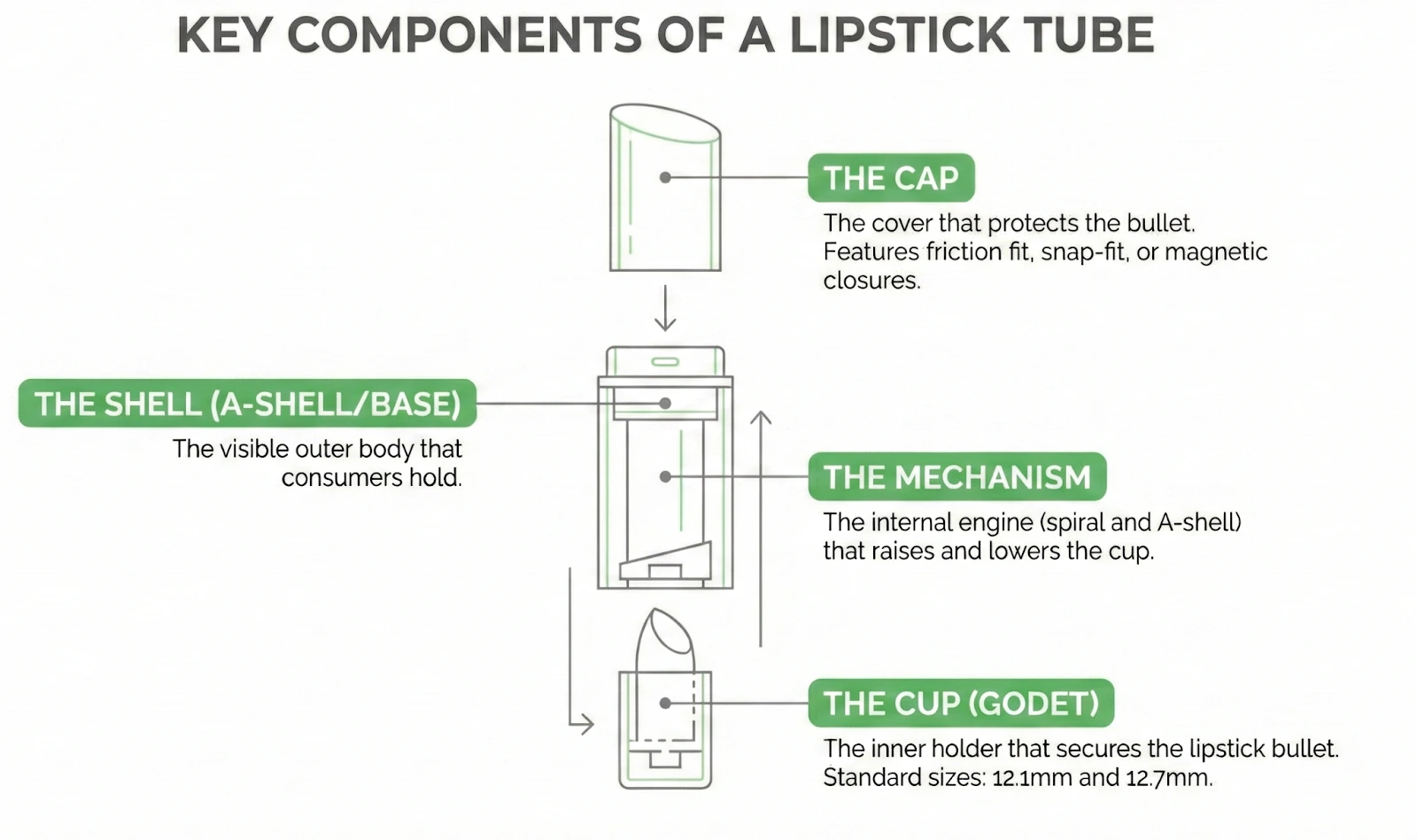
A standard lipstick tube consists of four primary components working in unison:
- • The Cup (Godet): The inner holder that secures the lipstick bullet. Standard sizes are 12.1mm and 12.7mm.
- • The Mechanism: The internal engine (spiral and A-shell) that raises and lowers the cup.
- • The Shell (A-Shell/Base): The visible outer body that consumers hold.
- • The Cap: The cover that protects the bullet, often featuring friction fit, snap-fit, or magnetic closures.
What is the difference between "Guided" and "Non-Guided" mechanisms?
For sophisticated buyers, this distinction is vital for product quality:
- • Guided Mechanisms: Feature internal tracks or "ribs" that stabilize the cup as it travels up. This reduces bullet wobble, preventing the lipstick from scraping against the side of the tube—crucial for soft, creamy, or high-pigment formulas.
- • Non-Guided Mechanisms: A standard, cost-effective option suitable for harder waxes or budget-friendly lines, though they offer less lateral stability for the bullet.
What are the benefits of aluminum vs. plastic lipstick tubes?
- • Aluminum Lipstick Tubes: Offers a "cold touch" and significant weight, which consumers subconsciously associate with luxury and high value. It allows for premium decoration like anodizing and embossing.
- • Plastic (ABS/AS/PP) Lipstick Tubes: Allows for intricate injection molding, transparency (for "glass-look" effects), and lower costs. New heavy-wall plastics can mimic the density of metal.
Selecting the Right Lipstick Tube for Your Brand
How do I choose the correct cup size (12.1mm vs. 12.7mm)?
The cup size must match your filling mold and bullet diameter.
- • 12.1mm: The global standard for most lipstick bullets. If you are using stock filling molds, this is likely your size.
- • 12.7mm: A slightly wider cup often used for premium, high-coverage formulations or larger volume sticks.
- •
Tip:
Always confirm the "retention beads" or ribs inside the cup match your formula's viscosity to prevent the bullet from falling out.
What is "Lipstick Wardrobing" or Refillable Lipstick Packaging?
Refillable packaging allows the consumer to keep a heavy, luxury outer case (often metal) and purchase simple, lower-cost refills. This trend, popularized by brands like Hermès and Dior, reduces waste and increases customer retention. The refill mechanism usually snaps or clicks into the reusable base.
Browse refillable lipstick packaging hereCan I customize the "click" sound of the closure for a premium brand?
Yes. For luxury brands, the haptics of the closure are engineered features.
- • Magnetic Closures: Provide a silent, smooth pull and a satisfying, audible "clack" upon closing.
- • Snap-Fit: Engineered tensions can be adjusted to create a firm "click" that signals security to the user.
Sustainability & Environmental Impact
Are lipstick tubes recyclable?
Traditionally, no. Standard tubes are made of mixed materials (plastic mechanism + metal shell + lubricant + glue) that are impossible to separate at a recycling facility. Even if the tube is monomaterial, it is often too small to be successfully recycled in municipal recycling facilities in the US.
However, sustainable options now include:
- • Mono-Material PP/PET: The entire tube (mechanism and shell) is made from a single type of plastic, designed to maximize recycle readiness as infrastructure evolves.
- • All-Aluminum: A premium option where the mechanism is metal-free or easily separable, leveraging aluminum's high recycling rate.
- • PCR (Post-Consumer Recycled) Content: Tubes made with 30-50% recycled plastic to reduce virgin material use.
What is the downside of paper lipstick tubes?
While highly sustainable (compostable/biodegradable), paper tubes rely on a "push-up" mechanism rather than a twist-up. This can be less precise for application and may not convey the "luxury" feel of a weighted component. They are best suited for lip balms or eco-centric indie brands.
Industry Applications & Trusted Suppliers
Who are the top suppliers for premium lipstick packaging?
For brands seeking sophisticated mechanisms and high-end finishes, we recommend partnering with established specialists:
- • WWP Beauty: A global leader in "Beauty with Purpose," WWP operates a dedicated rigid component factory in Taicang, China. They are a go-to for sustainable innovation, leveraging their "6R's framework" (Reduce, Reuse, Recycle, etc.) to offer award-winning refillable and mono-material designs. Their manufacturing model ensures rigorous quality control from concept to delivery.
- • Shinhan CM: Based in Incheon, South Korea, Shinhan CM is a premier choice for brands prioritizing design-led customization. With over 20 years of experience, they specialize in high-end decoration techniques—including hot stamping, digital printing, and silk screening—that transform standard stock molds into unique, brand-defining components. Their localized production ensures agility and premium Korean quality.
- • J-Cop (Jeong Hun): A veteran of the Korean beauty industry since 1990, J-Cop manufactures for one in five Korean cosmetic brands. They are renowned for having one of the largest libraries of lipstick stock molds and expertise in both metal and plastic fabrication. Based in Gyeonggi-do, they are an ideal partner for brands seeking OEM/ODM capabilities, competitive MOQs, and reliable "Made in Korea" engineering.
What is the typical lead time for custom lipstick tooling?
Creating a custom shape or unique mechanism is a capital-intensive process and can vary supplier to supplier.
- • Stock Components: 4–8 weeks (decoration dependent).
- • Custom Tooling: 12–16 weeks for molds + additional time for production. Brands looking for custom shapes should plan for a 6-month runway.