Frequently Asked Questions (FAQs) About Sourcing Lip Gloss Tubes
Lip gloss packaging is a complex assembly where aesthetics meet precise engineering. From the clarity of the vial to the resistance of the wiper and the tactility of the applicator, every component plays a crucial role in the consumer's application experience. Whether you are launching a clean beauty line or a high-shine plumping gloss, understanding the anatomy of a lip gloss tube is essential for sourcing packaging that performs as beautifully as it looks. Explore key FAQs below to navigate materials, applicators, and customization options.
Understanding Lip Gloss Tube Anatomy
What are the primary components of a lip gloss tube?
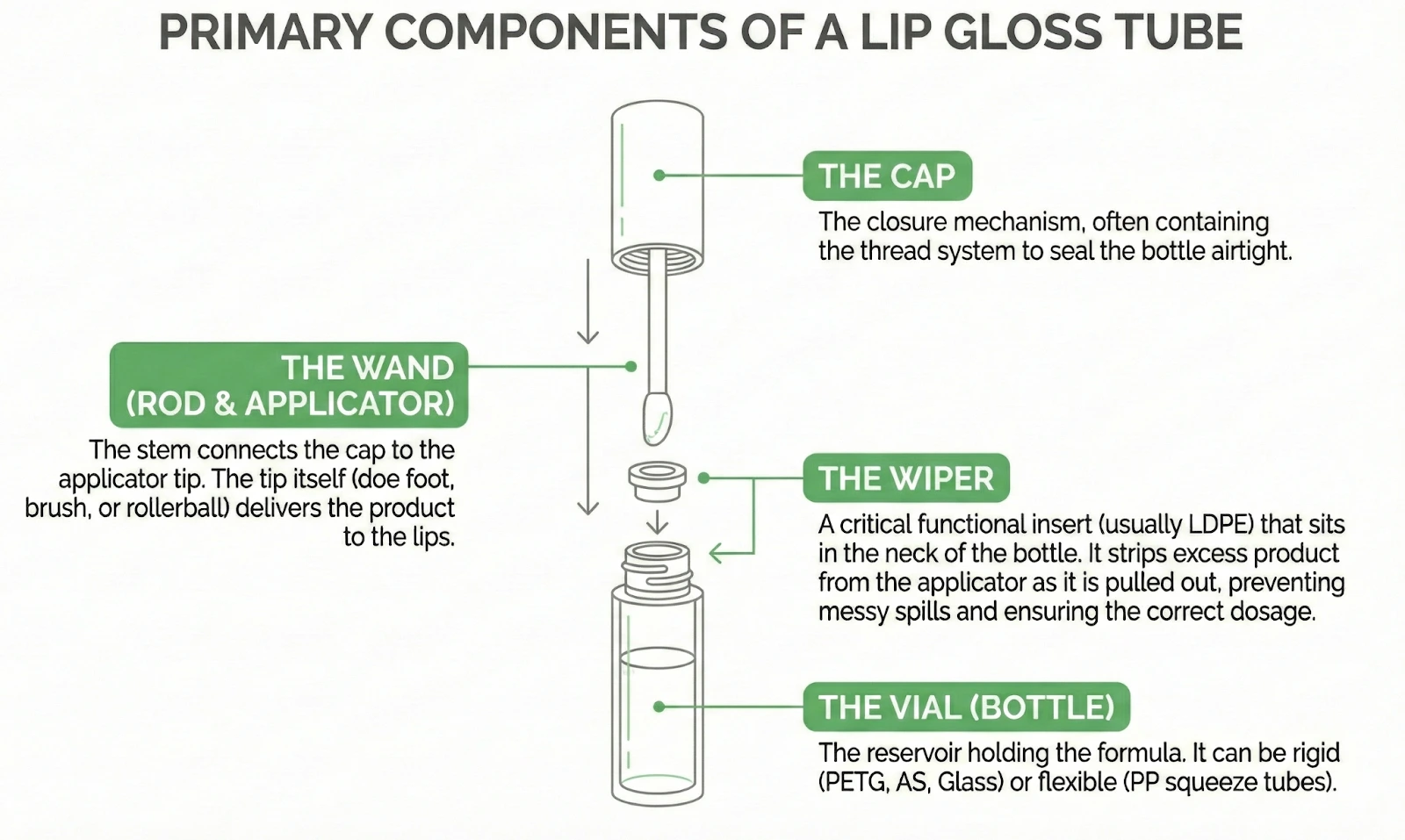
A standard lip gloss package consists of four distinct components that must function in harmony:
- • The Vial (Bottle): The reservoir holding the formula. It can be rigid (PETG, AS, Glass) or flexible (PP squeeze tubes).
- • The Wiper: A critical functional insert (usually LDPE) that sits in the neck of the bottle. It strips excess product from the applicator as it is pulled out, preventing messy spills and ensuring the correct dosage.
- • The Wand (Rod & Applicator): The stem connects the cap to the applicator tip. The tip itself (doe foot, brush, or rollerball) delivers the product to the lips.
- • The Cap: The closure mechanism, often containing the thread system to seal the bottle airtight.
Why is the wiper design so important?
The wiper controls the "payoff" or dosage of the product. A wiper that is too tight can strip the applicator bare, making the product frustrating to apply. A wiper that is too loose causes leakage and a messy neck. When sourcing components, it is vital to test your specific formula viscosity with the wiper to ensure a smooth, clean draw.
Selecting the Right Materials
What is the difference between PETG and AS for lip gloss vials?
CBoth are popular clear plastics, but they serve different needs:
- • PETG (Polyethylene Terephthalate Glycol) Lip Gloss Tubes: Offers superior chemical resistance and durability. It is less brittle than AS and is compatible with a wider range of aggressive formulations (like plumping glosses or volatile oils). It creates a thick-walled, glass-like aesthetic.
- • AS (Acrylonitrile Styrene) Lip Gloss Tubes: A rigid, crystal-clear plastic often used for cost-effective, high-clarity packaging. However, it is more brittle and has lower chemical resistance than PETG, making it better suited for standard, stable formulations.
When should I choose a squeezable tube over a rigid wand tube?
Yes, this category offers some of the highest customization potential in beauty packaging:
- • Rigid Wand Tubes (PETG/AS/Glass): Best for thinner, liquid-like glosses and oils that require an applicator for precision. They offer a more premium, "luxury" weight and feel.
- • Squeezable Tubes (PE/PP): Ideal for thick, high-viscosity balms and gels. They are generally more cost-effective and hygienic (no applicator re-entering the bottle), often preferred by "clean beauty" brands for their simplicity and lower weight.
Applicator Types & Functions
What are the different types of lip gloss applicators available?
The applicator defines the application experience:
- • Doe Foot: The industry standard. A flocked (fuzzy) angled tip that holds a specific amount of product and allows for precise contouring.
- • Large/Jumbo Doe Foot: A trend in recent years, offering a "one-swipe" full-coverage application, often paired with volumizing formulas.
- • Brush Tip: Made of synthetic bristles, offering a delicate, paint-like application. ideal for thin lip oils or nail cuticle oils.
- • Rollerball: A metal or plastic ball that rolls product onto the lips. Best for very thin, non-sticky oils and cooling treatments.
What are the different variations of doe-foot lip gloss applicators?
Short Answer: While the Classic Doe-Foot is the industry standard for lip gloss packaging, there are over a dozen specialized variations designed to enhance the consumer application experience. The most popular variations include the Reservoir Tip (for one-dip application), Jumbo and Paddle applicators (for full coverage), and Precision or Angled tips (for defining lip contours). The choice of applicator often depends on the formula’s viscosity and the desired payoff.
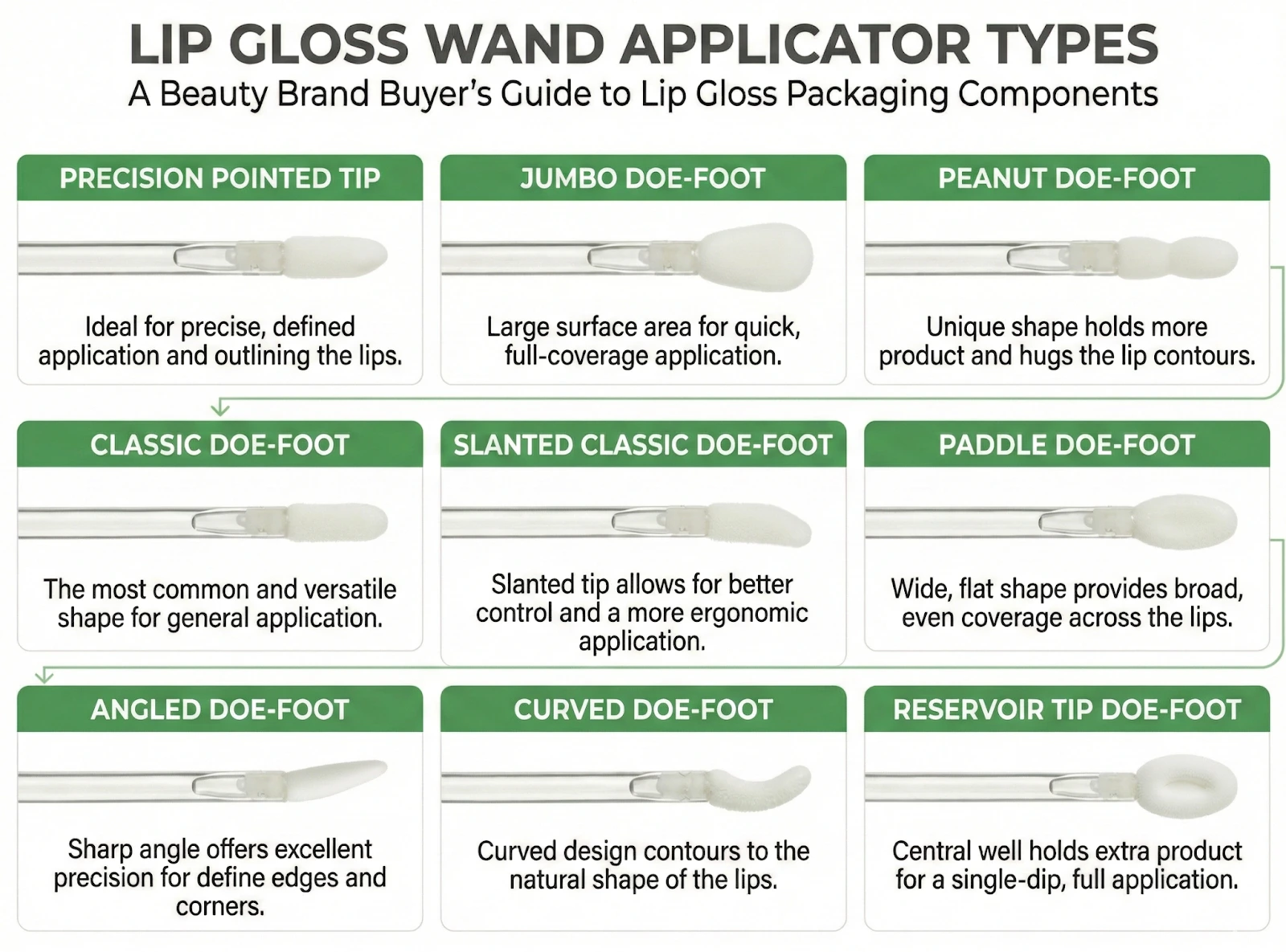
Detailed Breakdown: To help you select the right component for your packaging, we have categorized the 9 most common applicator shapes by their primary function:
1. The Standards (Versatile & Reliable)
These are the "workhorse" applicators suitable for almost any gloss, oil, or stain formula.
- • Classic Doe-Foot: The most recognizable shape; provides standard coverage and easy handling.
- • Slanted Classic Doe-Foot: A slight variation on the classic; the slant offers better ergonomics and contact with the lip surface
2. For High-Impact Coverage (Volume & Shine)
Best suited for thick, glittery, or high-shine formulas where the consumer wants a lot of product in a single swipe.
- • Jumbo Doe-Foot: A larger surface area that covers the lips quickly; ideal for maximizing the visual impact of the packaging.
- • Paddle Doe-Foot: Wide and flat, this flattens the product onto the lip for a glass-like finish.
- • Peanut Doe-Foot: The indented shape helps hold more product than a standard wand, allowing for a heavier laydown without dipping twice.
3. For "One-Dip" Application
- • Reservoir Tip Doe-Foot: Features a central well or "divot" in the middle of the applicator. This well traps extra product, preventing the need to pump the wand, which reduces air entering the tube and preserves the formula.
4. For Precision & Contouring
Best for highly pigmented liquid lipsticks or stains where staying "inside the lines" is critical.
- • Precision Pointed Tip: A tapered end tailored for outlining the cupid’s bow and corners of the mouth.
- • Angled Doe-Foot: Features a sharp, steep angle (steeper than the slanted classic) for distinct edge definition.
- • Curved Doe-Foot: Hugs the natural curvature of the lip, providing an intuitive and comfortable application experience.
Which lip gloss applicator shape is best for my product formula?
Matching your applicator to your formula’s viscosity and pigmentation is critical for consumer satisfaction. A mismatch can lead to messy leakage (if the formula is too thin for the tip) or poor payoff (if the formula is too thick for the stem).
Use this compatibility chart to help select the right component for your product line:
| Formula Profile | Ideal Applicator | Technical Benefit (The "Payoff") | Best For Viscosity |
|---|---|---|---|
| Lip Oils & Serums | Rollerball (Metal or Plastic) | Cooling & Massage: Metal balls provide a cooling effect that boosts the "treatment" perception. The ball mechanism strictly controls the flow of runny liquids to prevent dripping. | Very Low (Watery/Thin) |
| High-Pigment Lacquers | Brush Tip (Nylon Bristles) | Zero Absorption: Unlike flocked doe-foots, bristles do not absorb product. This ensures 100% of the pigment is deposited on the lip for maximum color intensity and a smooth, lacquer finish. | Medium-High (Opaque/Sticky) |
| Stains & Tints | Reservoir Tip or Peanut | Controlled Load: These shapes feature "wells" or indents that trap low-viscosity liquid, ensuring enough product is loaded for a single pass without needing to dip twice. | Low (Fluid) |
| Liquid Lipsticks | Precision Pointed or Angled | Definition: Sharp, defined edges allow the user to outline the lips like a liner before filling them in. Essential for matte formulas where mistakes are hard to correct. | Medium (Creamy) |
| Plumping & High-Shine | Jumbo or Paddle | Spatula Effect: The large surface area acts like a spatula, smoothing out a thick layer of product to maximize the light-reflecting "glass" effect. | High (Thick/Syrupy) |
| Glitter & Shimmer | Paddle or Slanted | Particle Transfer: A flatter surface prevents glitter particles from getting trapped deep in the flocking, ensuring the sparkles transfer effectively to the lips. | Medium-High (Textured) |
| Sheer / Everyday Gloss | Classic or Curved | The Standard: The curve hugs the lip for comfort, while the classic tip offers a balanced load for moderate coverage. | All / Universal |
Customization & Branding
How can I customize lip gloss components for my brand?
Mid-market brands can achieve a bespoke look through several decoration techniques:
- • In-Mold Color: Components (cap, bottle) can be injection molded in custom Pantone colors.
- • Metallization: Caps or bottles can be vacuum metallized to look like gold, silver, or rose gold..
- • Decoration: Silk screen printing, hot stamping (foil), and heat transfer labeling allow for intricate logos and patterns.
- • Soft-Touch Finishes: A spray coating that gives the component a velvet-like, matte tactile feel, popular in modern prestige packaging.
Sustainability & Sourcing
Are there sustainable options for lip gloss packaging?
Yes, suppliers are increasingly offering eco-conscious solutions:
- • PCR (Post-Consumer Recycled) Plastic: Vials and caps made from recycled PET or PP reduces reliance on virgin plastic.
- • Mono-Material Designs: Packaging where the bottle, cap, and rod are all made from the same material family (e.g., PP), simplifying recycle readiness as infrastructure evolves.
- • Refillable Systems: Premium components where the inner vial can be replaced while the consumer keeps the heavy, decorative outer shell.
What should I consider regarding compatibility testing?
Lip gloss formulations can be chemically active. Volatile ingredients, plumping agents (like cinnamon or menthol), and certain oils can attack plastic, causing cracking or clouding over time. It is mandatory to perform compatibility testing (stability testing) with your chosen supplier's samples and your specific bulk formula before placing a full production order.
Industry Applications & Suppliers
Who are trusted suppliers for lip gloss components?
Sourcing reliable components is critical to preventing leakage and component failure. Trusted suppliers known for quality cosmetic packaging include:
- • WWP Beauty: A full-service provider recognized for innovation and sustainability. They have a strong portfolio of patented sustainable components, including refillable and mono-material lip gloss tubes.
- • Quadpack: A global manufacturer and provider known for trend-led packaging and a strong commitment to sustainability. They offer a wide range of standard and bespoke lip gloss components with European styling.
- • Shinhan: A premier Korean manufacturer specializing in high-precision plastic molding. They are renowned for their airtight seals and heavy-wall PETG components that simulate the look and feel of glass, ideal for prestige positioning.
- • JCOP (Jeong Hun Co., Ltd): A leading Korean specialist in dispensing systems. JCOP is often the go-to source for technically complex applicators and blow-molded bottles that require strict tolerance control to prevent leakage in lower viscosity formulas.