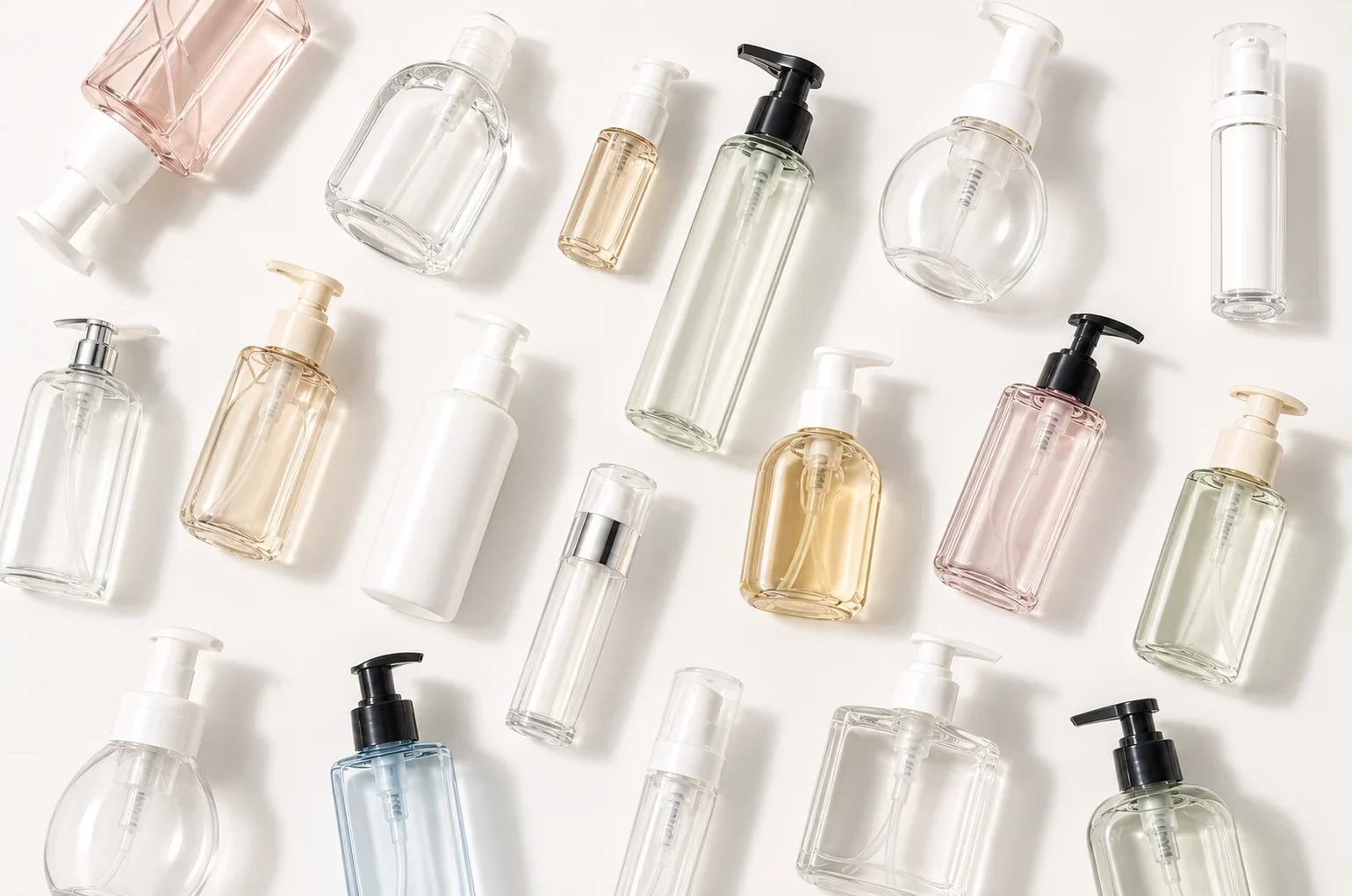
Pumps are a part of development that nobody budgets enough time for. Everyone's locked in on the bottle shape, the color, the label, and then at the eleventh hour, someone asks, "Wait, which pump are we actually using?" and suddenly the whole timeline wobbles. It makes sense, a pump isn't glamorous, but it plays a massive part in delivering the product experience.
This guide explains what you need to know when sourcing dispensing pumps: what a pump is made of, the different types of pumps and where each one belongs, airless vs. standard pump, how to match a pump to your formula's viscosity, neck finishes and thread compatibility, locking mechanisms, materials, and MOQ realities. It's long, but it's worth a bookmark if you find yourself working on really any personal care launch.
Looking to source dispensing pumps?
Parts of a Pump
First, it's important to understand what you're actually looking at when someone hands you a pump spec. Most dispensing pumps, whether we're talking serum pumps or lotion pumps, share the same basic skeleton.

- Actuator (the head): The part the user presses to dispense product. Available in a variety of shapes and designs to suit different applications and dispensing styles.
- Closure/Collar: The threaded component that secures the pump assembly to the bottle neck and holds the entire dispensing system in place.
- Gasket: A rubber or silicone seal positioned between the closure and the bottle neck to help prevent product leakage and create a seal between the closure and bottle neck.
- Stem: The central shaft that connects the actuator to the pump mechanism, transferring force to operate the pump with each press.
- Spring: Returns the actuator to its original position after each stroke, allowing the pump to refill for the next dispense.
- Housing (Pump Chamber): The stationary outer body that contains the pump chamber and guides the movement of the piston.
- Piston: The moving internal component that travels within the pump chamber, creating alternating suction and pressure to draw product up and dispense it.
- Ball Valve(s): One or more check valves that allow product to flow upward through the pump while preventing it from flowing back into the bottle between strokes.
- Dip Tube: The tube extending from the bottom of the pump to the base of the bottle, drawing product into the pump chamber during operation.
Different Types of Pumps
Pumps aren't one-size-fits-all; below are general guidelines by viscosity range, output per pump, and the use cases for each one.
Serum or Treatment Pump
Serum pumps are built for thin, fast-absorbing formulas where a little goes a long way, and when smaller dosages are preferred.
- Typical starting viscosity range: low, between 1 cP and 100 cP.
- Output: 0.1 cc to 0.5 cc
- Use cases: active treatments, eye creams, facial oils.
Serum pumps in market

Estee Lauder Revitalizing Supreme+ Sculpting Face Serum

Obagi Cellular Renewal Serum

Oak Essentials Serums
Foamer Pump
Foamer pumps run a dual-chamber system that draws in liquid and air through separate chambers, then forces both through an internal mesh screen so what comes out is foam, not liquid.
- Typical starting viscosity range: extremely low, 1 to 100 cP.
- Output: typically 0.4 cc to 1.5 cc
- Use cases: face wash, haircare, cleaning products/soaps.
Foamer pumps in market

Bath & Body Works Gentle & Clean Foaming Hand Soap

Sonsie Cleansing Mousse

Method Foaming Hand Wash
Lotion Pump
Lotion pumps are what most people picture when they hear the word "pump." They are designed with larger pump chambers and higher output volumes, allowing them to dispense thicker creams and lotions efficiently.
- Typical starting viscosity range: medium to high, 3,000 to 80,000 cP
- Output: 0.5 cc to 4.0 cc
- Use cases: creams, suncare, body washes
Lotion pumps in market

Osea Undaria Algae Body Lotion

Native Moisturizing Shampoo

OUAI Hand Wash
Condiments Pump
The first thing to check with a food or condiment pump is whether its materials and components are suitable for the intended food-contact application and target market. Food-contact requirements add a compliance layer that many cosmetic pump applications don't have, so ask the supplier what supporting documentation is available for the specific pump you're considering.
Temperature matters too. If the filled product, filling process, storage conditions, or service environment exposes the pump to elevated temperatures, confirm the supplier has validated the pump for those conditions.
- Typical starting viscosity range: covers a huge range, 1 cP to 250,000 cP
- Output: typically 0.5 oz to 1.25 oz (some dispensers use plastic rings on the pump shaft to physically restrict the amount of product that will come out)
- Use cases: sauces, syrups, spreads
Condiments pumps in market

Nooly Syrup

Moni Sea Salt Caramel Toffee Sauce

Ghirardelli Caramel Sauce
Well Pump (Nail Polish or Toner)
Most well pumps are designed to dispense product directly onto a cotton pad or applicator. The goal is controlled dispensing, enough product to saturate the pad without wasting formula or creating a mess.
- Typical starting viscosity range: very thin, water-like, 1 to 5 cP
- Output: 0.2 ml to 0.5 ml per stroke, intentionally small
- Use cases: nail polish remover, toner, professional sanitation
Well pumps in market

Londontown Lacquer Remover Pump

Furtuna Skin Acqua Serena Micellar Essence

Depend Pump-In Nail Polish Remover
Toothpaste Pump
Toothpaste is a non-Newtonian formula, and many toothpaste systems exhibit yield-stress and shear-thinning behavior: they resist flow at rest but move much more readily once enough force is applied. This makes it harder to pump than a simple liquid. Toothpaste dispensers typically use airless or piston-driven dispensing systems because gravity alone isn't sufficient to move such a high-viscosity product. There are suppliers that specialize in toothpaste pumps and actively innovate in this area because this formula brings a host of challenges that most lotion pump dispensers rarely see.
- Typical starting viscosity range: very high, 100,000 to 300,000 cP
- Output: a "pea-sized" dose, 0.8 cc to 1.5 cc
- Use cases: toothpaste
Toothpaste pumps in market

Hismile Pap+ Teeth Whitening Toothpaste

Smile Therapy Flavoured Toothpaste

GlorySmile Teeth Whitening Toothpaste
Airless vs. Traditional Dispensing Pump: What's the Difference
An airless system is a specific kind of pump mechanism. The main distinction is how the system handles replacement air as the product is used.
A standard atmospheric pump typically uses a dip tube and allows replacement air into the container as product is dispensed. Airless systems are designed to dispense product while limiting replacement air from entering the product chamber. Many common airless bottles use a follower piston that rises as product is dispensed, although other airless architectures also exist. Here's the comparison:
| Factor | Standard Pump | Airless Pump |
|---|---|---|
| Air exposure | Air enters as product is used | Designed to limit replacement air entering the product chamber |
| Best for | Stable, less oxygen-sensitive formulas | Oxidation-prone actives (vitamin C, retinol, peptides) |
| Product usage | Some residual product gets left behind | Often supports high product evacuation rates |
| Orientation | Generally needs to stay upright | Some designs support multi-angle dispensing |
| Cost | Lower, simpler mechanism | Higher, more components and tighter tolerances |
| Dip tube | Required | Often uses a follower piston or another airless product-feed architecture |
If your formula contains actives that are sensitive to oxygen exposure, an airless system is worth considering—though always weigh the tradeoffs of cost and viscosity requirements for your specific application.
Selecting a Pump to Match Your Formula's Viscosity
Viscosity mismatch is one of the most common reasons a pump "fails" in the field, and it's rarely that the pump is defective; it's that the pump and formula were not matched correctly.
Use the table below as a starting point—viscosity ranges can vary by supplier and pump design, and other factors like formula density, surface tension, and ingredient compatibility also influence how well a pump performs. cP stands for centipoise, the standard unit for viscosity. For reference, water sits at roughly 1 cP.
| Typical Starting Viscosity Range (cP) | Pump Type | Typical Output | Example Formulas |
|---|---|---|---|
| 1-5 | Well pump | 0.2-0.5 cc | Toner, nail polish remover |
| 1-100 | Serum/treatment, foamer | 0.12-1.5 cc | Serums, facial oils, face wash |
| 3,000-80,000 | Lotion pump | 0.5-4.0 cc | Lotions, creams, suncare |
| 1-250,000 | Condiments pump | 15-37 cc | Sauces, syrups, spreads |
| 100,000-300,000 | Toothpaste/airless | 0.8-1.5 cc | Toothpaste, dense pastes |
Pump Cycles, Prime Ratio, and "How Many Pumps Until Product Comes Out"
A pump that's never been used arrives "dry," meaning the chamber and dip tube are full of air, not product. Priming is the process of pumping enough times to push that air out and pull liquid up into the chamber for the first time.
- Pump cycle: one complete down-and-up motion of the actuator. Each cycle either primes the pump or dispenses a dose, depending on whether the chamber is already full of product.
- Prime ratio: the number of pumps required before the product reliably comes out of a fresh pump, typically anywhere from 2 to 8 pumps, depending on dip tube length, formula viscosity, and pump design.
- Why this matters commercially: if your prime ratio is high and you don't disclose it, you could get reviews and support tickets from people who think the pump is broken on arrival. A simple "prime with several pumps before first use" line on your packaging can save you a real amount of customer service headaches.
Ask your supplier for the tested prime count on your exact bottle and pump combination rather than relying on a generic specification. Even small changes in bottle height alter the dip tube length, which can affect how many strokes it takes to prime the pump.
Dip Tube Length: Getting It Right
The dip tube is the straw-like extension that reaches from the pump mechanism down to the bottom of the bottle, allowing the pump to draw product. If it's too short, you'll leave product behind at the bottom. If it's too long, it'll buckle or crimp against the base, blocking flow entirely.
Depending on the supplier and program, pumps may come with dip tubes cut to specification or with additional length for trimming. The goal is usually to position the tube close enough to the bottle base for good evacuation without allowing it to bottom out, buckle, or obstruct flow. Follow the pump supplier's recommended dip-tube specification for the actual bottle.
If you're using non-standard bottle shapes (tapered bases, wide shoulders, unusual footprints), always do a fit test before committing to a production run. A dip tube that works perfectly in a cylindrical bottle may not reach the corners of a square or oblong bottle, leaving pockets of unreachable product.
Neck Finish and Thread Compatibility
Not every pump fits every bottle. Pumps and bottles are matched by neck finish, a standardized measurement of the bottle's neck diameter and thread pattern, and if those numbers don't match, the pump either won't thread on or won't seal properly.
Neck finish is typically written as two numbers, such as 24/410. The first number refers to the nominal diameter of the container's neck finish in millimeters—not the diameter of the opening itself. The second number identifies the finish or thread series. Together, they describe the closure interface the pump needs to match.
A pump and bottle can have the same nominal diameter and still be incompatible if the finish series, thread geometry, sealing surface, or other dimensions don't match.
- 18/415: common on smaller dropper and well-pump bottles, like toners and nail polish remover.
- 24/410: a frequent choice for serum and treatment pump bottles in the 30ml to 50ml range.
- 28/410: shows up often on slightly larger treatment and lotion-adjacent bottles.
- 38/400: common on larger lotion and body care bottles, where higher output pumps need a wider neck to seat properly.
An important thing to note is that the second number isn't interchangeable even at the same diameter. A 24/410 pump will not seal properly on a 24/400 bottle, even though the diameter is the same. We also recommend always testing the pump with your actual bottle before committing to a production run—even when the neck finish numbers match, slight manufacturing tolerances between suppliers can occasionally cause fit or seal issues.
Not sure which neck finish you need? Book a quick call with our packaging team and we can help you match your bottle to the right pump.
Locking Mechanisms and Shipping Challenges
A pump that can actuate freely during transit has a much higher chance of becoming a very messy problem. Locking mechanisms exist to hold the actuator in a fixed position so the pump can't compress during handling, freight vibration, or temperature swings in transit.
- Lock-up: the actuator twists and locks in the raised position. Common, simple, low cost.
- Lock-down: the opposite, the actuator locks in the depressed position, compressing the spring fully so it can't move at all.
- Twist lock: a rotation of the head itself (not necessarily up or down) engages internal tabs that block the stroke.
- Clip lock: a separate plastic clip is added around the stem or collar, physically blocking compression. This overlaps a lot with what people call a ship clip, more on that next.
- Snap lock: a simple snap-fit tab that engages with light pressure and can be fast to apply on a filling line, with transit performance varying by design.
| Mechanism | How It Works | Sourcing Consideration |
|---|---|---|
| Lock-up | Actuator twists and locks in the raised position | Integrated lock; validate transit performance with the finished package |
| Lock-down | Actuator locks in the depressed position | Compact shipping profile; opening and priming behavior varies by design |
| Twist lock | Rotation of the actuator engages internal locking features | Integrated locking without a separate clip |
| Clip lock / ship clip | Separate clip physically prevents actuator compression | Useful where accidental actuation during parcel shipping is a concern |
| Snap lock | Snap-fit feature limits actuator movement | Performance varies by design; validate against the intended distribution environment |
Longer supply chains usually mean more handling events, vibration, stacking, temperature variation, and opportunities for something to go wrong. International shipments can make those failures more expensive, so validate the locking system and secondary packaging against your actual distribution environment.
What Does an E-Commerce Ship Clip Do (and When You Need One)

Quick definition: a small plastic clip positioned beneath the actuator that physically prevents the pump from being depressed during shipping. Without one, the actuator can get pressed during normal handling, jostling in a box, another package stacked on top, a delivery van hitting every pothole on the route, and that single accidental actuation is often all it takes to start a leak that ruins the whole shipment.
Here's the thing nobody tells first-time DTC brands: retail shelf packaging and e-commerce packaging are not the same shipping environment. A bottle sitting upright in a case on a pallet headed to a distribution center experiences almost no compression risk. That same bottle tossed into a poly bag or a loosely packed mailer, possibly upside down, possibly under three other items, is a completely different story.
- Without a ship clip, the actuator compresses under pressure and product leaks, often discovered only when the customer opens a soggy box.
- A ship clip blocks accidental actuation specifically during the handling and transit window, then gets removed by the customer before first use.
- International shipping raises the stakes further: longer transit times, more handoffs, temperature and altitude changes if it's going by air. If your distribution environment creates a meaningful risk of accidental actuation—especially parcel shipping—a ship clip is worth evaluating early rather than discovering the need for one after your first leakage complaints.
If you're selling DTC in meaningful volume, test the complete package in its actual parcel-shipping configuration and consider a ship clip or another actuation-control solution from the beginning. It's a cheap line item next to the cost of a damaged-product refund, a bad review, and a customer who doesn't reorder.
Compatibility Testing: Test Before You Commit
Before finalizing any pump, you need to run compatibility testing with your actual formula—not a similar formula, not an industry benchmark, your actual formula. This isn't a formality; it's the step that catches problems before they become expensive.
Compatibility testing evaluates how your formula interacts with the pump materials over time. You're checking for:
- Chemical compatibility: Does the formula degrade or react with any of the pump components (gaskets, seals, plastics)? Some active ingredients or solvents can cause swelling, cracking, or deterioration of rubber and silicone seals.
- Dispensing performance: Does the pump consistently deliver the correct dose across the product's expected shelf life? Viscosity can shift over time, especially with emulsions.
- Seal integrity: Does the pump maintain a proper seal after repeated use, or does it start leaking after a certain number of actuations?
- Actuation force: Is the force required to operate the pump consistent and appropriate for your target consumer?
Work with your packaging supplier, contract manufacturer, formula team, or testing partner to establish an appropriate compatibility and stability-testing protocol for the complete package. Testing upfront is much cheaper than discovering a package-performance problem after production.
Materials, MOQ, and Stock vs. Custom
Pumps are typically built from a mix of polypropylene (PP) housings, stainless steel springs, and a silicone or rubber gasket, sometimes with metal collars for a more premium feel. The material mix affects cost, weight, recyclability (section 10), and how the pump actually feels in hand.
On the sourcing side, the decision that actually moves your timeline and budget is stock versus custom.
- Stock pumps: existing molds, existing color and finish options, lower MOQs, often available in days or weeks rather than months. The tradeoff is you're choosing from what already exists, no unique actuator shape, no custom branding embossed into the collar.
- Custom pumps: new tooling built to your spec, full control over shape, finish, and branding, but MOQs jump significantly and lead times stretch out to account for mold development and testing. Most brands don't need to jump straight into completely custom pump tooling. There are a lot of strong stock platforms that can be customized through color, finish, collar treatments, and other options before you start paying for a brand-new mold.
MOQs vary a lot by supplier and by how custom you're going. We've seen suppliers offer pumps at MOQs as low as a few thousand units for stock items, scaling up to 10,000-plus for semi-custom decoration, and well into the tens of thousands once you're talking fully custom tooling. Unless the actuator itself is part of the product innovation, stock or semi-custom is usually the smartest place to start until your volumes justify the custom investment.
For a detailed breakdown of what to look for when inspecting pump samples, see our guide to common pump defects and how to avoid them.
What to Specify When Requesting a Quote
When you reach out to a supplier for pump pricing, the more specific you are upfront, the faster and more accurate the quote will be. Here's a checklist of what to include:
- Bottle / container: bottle SKU, dimensions, neck finish, or technical drawing
- Formula: product type, viscosity, and any relevant characteristics such as particulates, solvents, oils, or unusual rheology
- Pump type: serum, lotion, foamer, airless, etc.
- Output volume: the dose per actuation (e.g., 0.5 cc, 2.0 cc)
- Neck finish: the exact specification (e.g., 24/410, 28/400)
- Dip tube length: if you know the interior height of your bottle, include it; otherwise, request a trimmable dip tube
- Locking mechanism: twist-lock, lock-down, ship clip required, etc.
- Materials: standard multi-material, monomaterial (all-PP), PCR content requirements
- Color and finish: natural, white, custom Pantone, matte, glossy, metallic
- Decoration: embossing, debossing, silk screen, hot stamp
- Compliance requirements: applicable food-contact documentation, child-resistant requirements, or other market- and application-specific requirements
- Estimated annual volume: this helps negotiate pricing with suppliers. Know your first order volume definitively, and share an annual estimate as well
- Target delivery date: be realistic; custom tooling can take 60-90+ days
Having this information ready before you request samples or quotes will save you multiple back-and-forth emails and help suppliers give you accurate lead times.
Are Pumps Recyclable? PCR, Monomaterial, and Reduced Plastic Design
Short answer, and it's not the answer most brands want to hear: conventional pumps are often difficult to recycle in practice. The reason comes down to how a pump is built.
A typical pump combines several different materials in one small assembly: a plastic housing, a metal spring, a rubber or silicone gasket, and sometimes a metal collar. Recycling facilities sort materials based on the capabilities of their specific systems, and small, multi-material components like pumps can be difficult to separate and process effectively. So even when the plastic components are made from recyclable polymers, the assembled pump may not be accepted or successfully recycled through many conventional recycling streams.
Why Monomaterial Is Gaining Ground
Monomaterial pumps remove the mixed-material problem at the source by building the entire pump out of a single polymer family, most often all-PP. Building the pump primarily from one compatible polymer family can improve its recyclability potential because recyclers don't have to contend with the same mix of incompatible materials found in a conventional pump.
That doesn't automatically mean every curbside program will accept or successfully recycle the component. Collection, sorting, package size, local infrastructure, and the recycling stream still matter.
The tradeoff right now is that monomaterial pumps often rely on alternative return mechanisms instead of traditional metal springs, which can affect dispensing feel and compatibility depending on the design. They're also not available across every viscosity range yet.
Post-Consumer Recycled (PCR) Resin
PCR resin is plastic that's been recycled out of the consumer waste stream and reprocessed into new material, as opposed to virgin plastic made from new petroleum feedstock. Using PCR in a pump's housing reduces demand for virgin resin, and it's become a meaningful selling point for sustainability-minded brands.
PCR and monomaterial construction address different packaging questions: PCR changes where the resin comes from, while monomaterial construction can improve end-of-life compatibility. Brands may pursue both where the engineering and application allow it.
Dispensing Pump Manufacturers & Suppliers
Once you know the pump type, neck finish, output, and formula requirements, supplier selection gets a lot easier. Compare dispensing pump manufacturers and suppliers based on the specifications that actually affect the project: pump platform, neck finish, output, formula compatibility, MOQ, stock availability, manufacturing location, customization options, and supporting technical documentation.
Several suppliers have built strong pump programs worth knowing. CLC has been specializing in dispensing pumps, sprayers, and aerosol valves since 1994. Their catalog spans lotion pumps, treatment pumps, foam pumps, airless systems, and trigger sprayers, and their monomaterial all-PP pump line is APR certified and available with an e-commerce ship clip built in. ZJ Pack is a China-based cosmetic pump specialist worth knowing for two reasons: their patented pump-back technology, which draws residual oil back into the nozzle after each use to prevent leaking and clogging on oil-based formulas, and their monomaterial all-plastic pump that eliminates the metal spring to make the component fully recyclable. UKPACK is the call for food and beverage-grade dispensing pumps, and also carries a selection of monomaterial pumps. Calaso carries a wide range of serum and lotion pumps across multiple neck finishes, with inventory warehoused in California and New Jersey.
Frequently Asked Questions
How do I choose the right dispensing pump?
Start with your formula's behavior—viscosity, density, and any challenging ingredients like particulates or solvents. From there, determine your desired dosage/output, then match to an appropriate pump family (serum, lotion, foamer, airless, etc.). Confirm the bottle neck finish, size the dip tube correctly, decide on locking requirements for your distribution channel, and run compatibility testing with the actual formula before committing to production.
How do I know if a pump will fit my bottle?
Neck finish is the starting point—match both the nominal diameter and finish series (e.g., 24/410). But matching the nominal finish alone doesn't guarantee compatibility. Thread geometry, sealing surface, and manufacturing tolerances can all cause fit or seal issues. Always validate the actual bottle/pump combination before production.
What does 24-410 mean on a pump?
24 refers to the nominal diameter of the neck finish in millimeters—not the bottle opening—and 410 identifies the finish or thread series. Together, these numbers describe the closure interface that the pump needs to match. Both numbers must align between your bottle and pump for a proper fit and seal.
What pump output should I choose?
Output should reflect the intended dose and user experience. A serum might need 0.2 cc per actuation while a body lotion might need 2.0 cc or more. Outputs vary by pump type and design, and the final selection should be tested with the actual formula to confirm the dispensing behavior matches your expectations.
What information should I send a dispensing pump supplier for a quote?
Include your bottle or container details (SKU, dimensions, neck finish, or a technical drawing), formula characteristics (viscosity, product type, any unusual rheology), desired output, quantity, dip tube length or interior bottle height, locking requirements, color/finish preferences, target market and compliance needs, and target delivery date. The more detail upfront, the faster and more accurate the quote.
For more answers, see our pump FAQ page.
That's the full rundown. Pumps look simple from the outside, but the engineering underneath determines whether your formula actually dispenses the way you designed it to. Get the pump family right, match the bottle and neck finish, size the dip tube correctly, understand the output, and then test the complete package with the actual formula.
Have a specific formula or bottle you're trying to pair with a pump? Browse dispensing pumps on Impacked to compare suppliers, neck finishes, outputs, MOQs, and manufacturing locations—or request quotes, samples, or technical documents from suppliers.
Want to talk through your project? Reach out to our packaging specialists at [email protected] or schedule a call today.